
About that term 'DAO'


This article discusses the various ways the term DAO (Decentralized Autonomous Organization) is used across the industry and to offer some definitions and distinctions for this term and related terms and how it is used in this series of articles. It is part of a series of articles that explore how verdicts with veracity can be achieved wholly within the nym nation and how a common law will evolve in the nym nation, unencumbered by nation-state legislative rules-based distortions.
A DAO is often considered an organization represented by rules encoded in on-chain smart contracts that are transparent and controlled by the smart contracts’ admin. Hence ‘autonomous.’ Often the DAO comprises a community of governance token holders who, as a collective, make decisions for the DAO and apply any changes required of the smart contracts. Hence ‘decentralized.’ To note, this loose definition of DAO is not intended to be definitive, but to merely act as a common reference point against which distinctions are made throughout this article.
A DAO may or may not be incorporated in the domain of a nation state. Accordingly, a DAO may or may not be subject to government regulations that may apply within a nation state.
The enabling technology of censorship-resistant value transfer using cryptocurrencies can help enable organizations to operate on the global stage outside the nation state. This has been a key factor in the recent popularization of the term DAO.
The other key driver is automatic operations via smart contracts that can help ensure the DAO’s operations are similarly censorship-resistant. However, this is not mandatory for an organization to operate in the nym nation. All that is required is that the organization and, more specifically, the individuals who operate the organization are not doxxed.
Though the ‘A’ in the term DAO implies autonomous operations via smart contracts, in practice it has transpired that DAOs still require humans to perform a proportion of their operations. Hence the ‘autonomous’ aspect of any given DAOs may be considered on a continuum from no smart contract automation through to highly automated. And, to emphasize, some ‘DAOs’ exist which employ little or no autonomous operation.
A DAO may elect to be registered with a nation state for various reasons. These include so that the DAO can interact more easily with state-registered organizations and financial systems if needed. There are many cases of this, such API3, for example. In such cases, the nation-state regulations that apply to any organization registered in that nation state will also apply to such DAOs. This will be a decision that each DAO will make separately. Such organizations are considered ‘doxxed’ and are therefore not pseudonymous entities operating wholly in the nym nation. Such organizations may engage with wholly-nym-nation entities, but they are subject to the regulations of the nation state in which they reside.
So, the term DAO is often used to refer to a range of organizations from almost fully-automated through to being manually administered and from having decentralized governance through to being highly centralized. And DAO may refer to an organization which may or may not be doxxed.
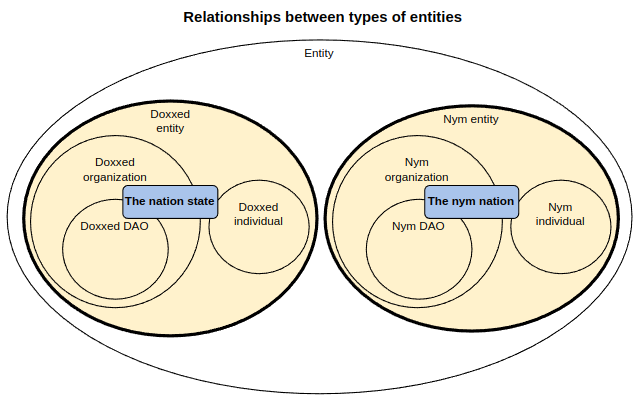
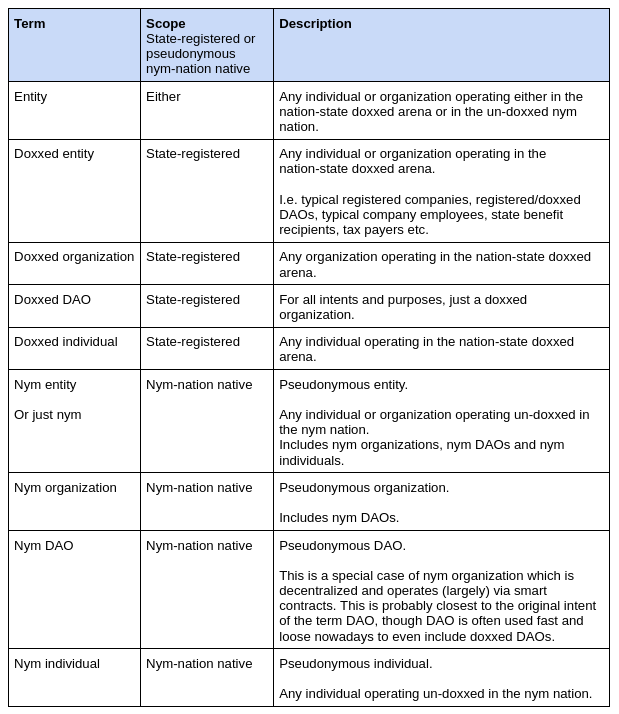
Despite the above problematic use of the term ‘DAO’, this article defines the following terms to distinguish between various types of entities. The diagram below presents a view of the relationships between the types of entities that we define later in the table below.
For individuals involved with nym organizations to not be subject to influence by nation-state actors, these individuals must be pseudonymous. (We might in future publish an article of considerations relating to operational security for pseudonymous entities.)
With better facilities, including a robust and extensible reputation system within the nym nation to enable nym entities to contract and settle disputes and where disputes have veracity all within the nym nation, (certain) entities will conduct an increasing amount of their commerce wholly within the nym nation. This will necessarily largely exclude organizations which have physical presence, though it will be possible for some of their activities to occur in the nym nation.
—
Cryptocurrencies give entities the ability to permissionless transfer value between themselves. Censorship resistance. Dispute resolution systems for the nym nation must also allow disputes to be resolved in a manner that is unencumbered by state actors, wholly within the nym nation. The nym nation does not have the utility of force to assure veracity of verdicts as do nation states. Without forceful dispute verdicts, there will be severe limits to the value nym entities will be willing to contract with one another and, accordingly, there will be severe limits to the scalability of the nym nation. Subscribe to this blog as we unfold how this ideal of verdicts with veracity can be achieved wholly within the nym nation and how a common law will evolve in the nym nation, unencumbered by nation-state legislative rules-based distortions.
This is a new frontier.